

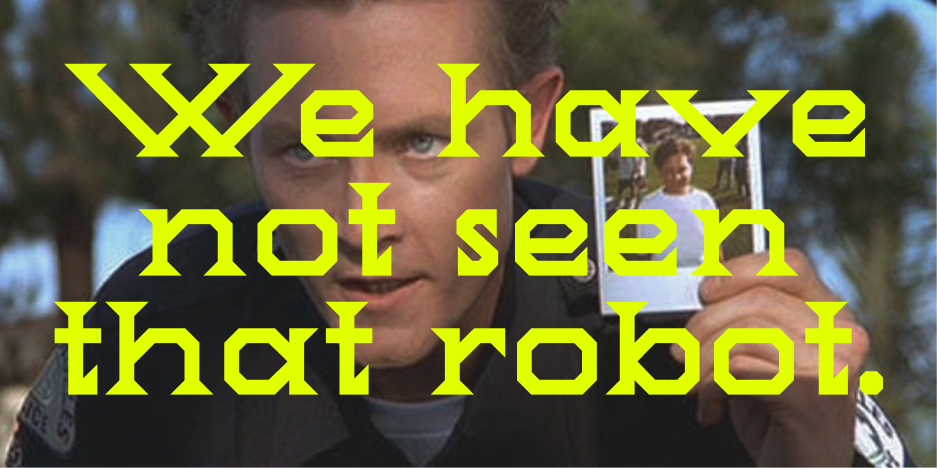
Cover image credit

Reading

Information
ABOUT
This is an index of robots, real and imagined.
The index is a work in progress and will stay one, since the history of robots is still being made. For now it’s a one-person project, so gaps and errors are likely. Corrections are welcome.
Authored by Able Parris
Why
A robot’s appearance is never neutral. Whether it looks like a toy, a dog, or a hockey puck, each design decision is as much about trust as it is about utility.
This project began with a viral video of a humanoid robot in a hoodie and basketball shorts, awkwardly walking a robot dog on a leash down a city street. No one ran. Some people stopped to film it. It was almost comical, but it raised a question: what does a robot’s appearance communicate?
This archive doesn’t answer that question. From the bronze guardians of ancient myth to the felted home robots of today, each entry aims to record the robot’s appearance and its intended purpose, so that we can compare them for ourselves. It records how robots look and what they were meant to do, so that we can compare them for ourselves. By collecting fictional and real-world robots in one place, it lets us trace how robot designs have changed over time. Dangerous robots in fiction are often legible as threats: a red eye, a skeletal frame, a cold voice. When a dangerous robot looks trustworthy, with the face of a sister, its betrayal feels even more brutal.
The robots entering homes now look more like toys, pets, or even furniture. Whether that shift reflects better design or better marketing is a question this archive can help us ask.
What counts as a robot
The definition here is broad: an artificial being or machine built, or imagined, to act on its maker’s behalf.
Each entry includes:
- Origin:
- fictional or real, with year and source
- Form:
- humanoid, human-passing, zoomorphic, industrial, abstract, or other
- Appearance:
- a written description of materials, proportions, face, clothing, and color
- Purpose:
- what the robot was designed or written to do
- Fate:
- destroyed, retired, still operating, or unknown
- Fatality record:
- whether the robot has caused a human death, with sources
- Image:
- one image, with credit and a link to its source
Entries for fictional robots cite the specific text, film, or game they come from. Where a character changes across retellings, as Talos does between Apollonius and later accounts, the entry notes the variants.
The fatality record
This archive aims to document whether a robot has taken a human life, though attributing a death to a machine is rarely simple. These entries are not meant to be sensational. They belong in the record because they belong to the history, and that history is still being written.
Contribute
Know a robot that's missing? A film, a game, a startup demo, a 1950s toy, a factory arm with a history? Submit it, with a source. Spotted an error? Tell us that too.